

A lot of climate change talk is about fossil fuels, greenhouse gases, and global warming. But, we rarely talk about the economic’s side, the side that can truly help us find a very important way to aid in this crisis.
When companies track their sustainability, they may say that they have no emissions or set that goal. But what they fail to take in account is scope 3 emissions.
What are scope emissions? Let me give you a rundown.
Scope 1 emissions are direct emissions. For example, if you are driving, you are directly emitting. Scope 2 emissions are indirect emissions, specifically electricity. If you were to turn on the lights, that would be Scope 2. Lastly, Scope 3, another indirect emission. Foods, clothing, anything manufactured and distributed is Scope 3.
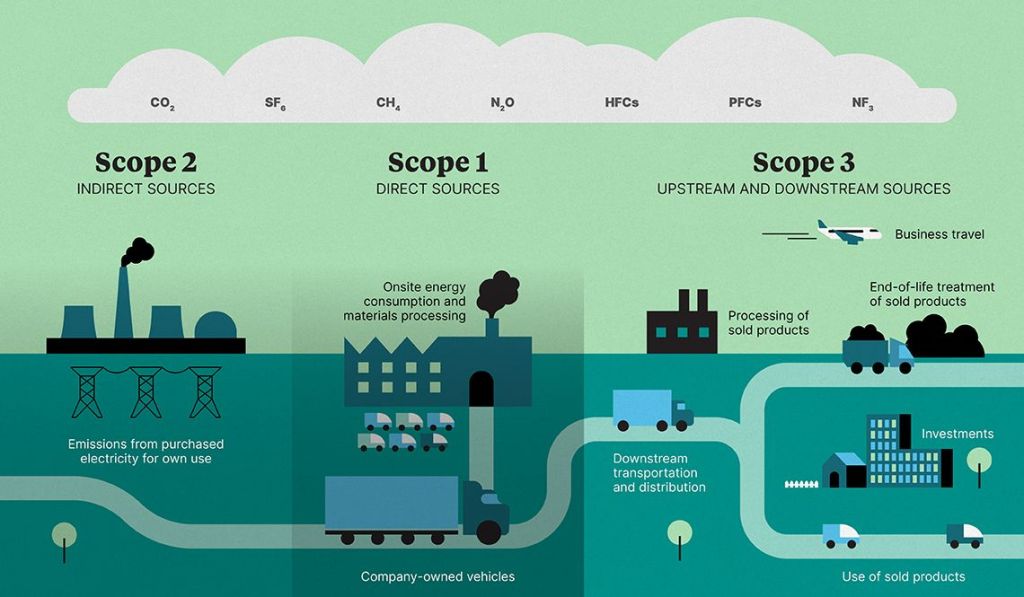
Why is important that companies take in account their Scope 3 emissions? Scope 3 emissions can account for 75% of emissions for big companies, so if we are only measuring 1 and 2, we are really not taking in account the actual emissions being used.
To stay below 1.5*, we need to reduce these emissions 50% by 2030. So how do we do this? The answer is circularity.
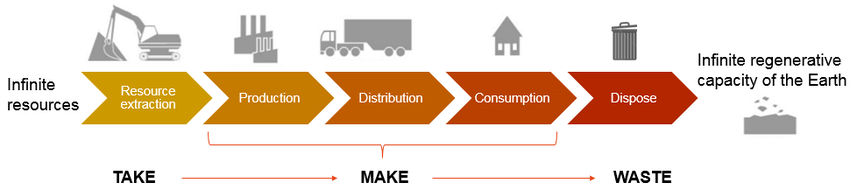
In most economic practices today, we have a linear economy. A linear economy is based on the idea that we have infinite resources and regeneration. This is not true. The world is composed of finite resources, which means that the linear economy cannot keep being our production method.
This is why we should begin to use a circular economy. You may be asking yourself what exactly a circular economy is.
In a circular economy, raw materials are designed in a more sustainable way, then produced, distributed, consumed, collected, and then recycled. Then this continues to repeat. Of course there is still some raw materials and waste, but it is much less.
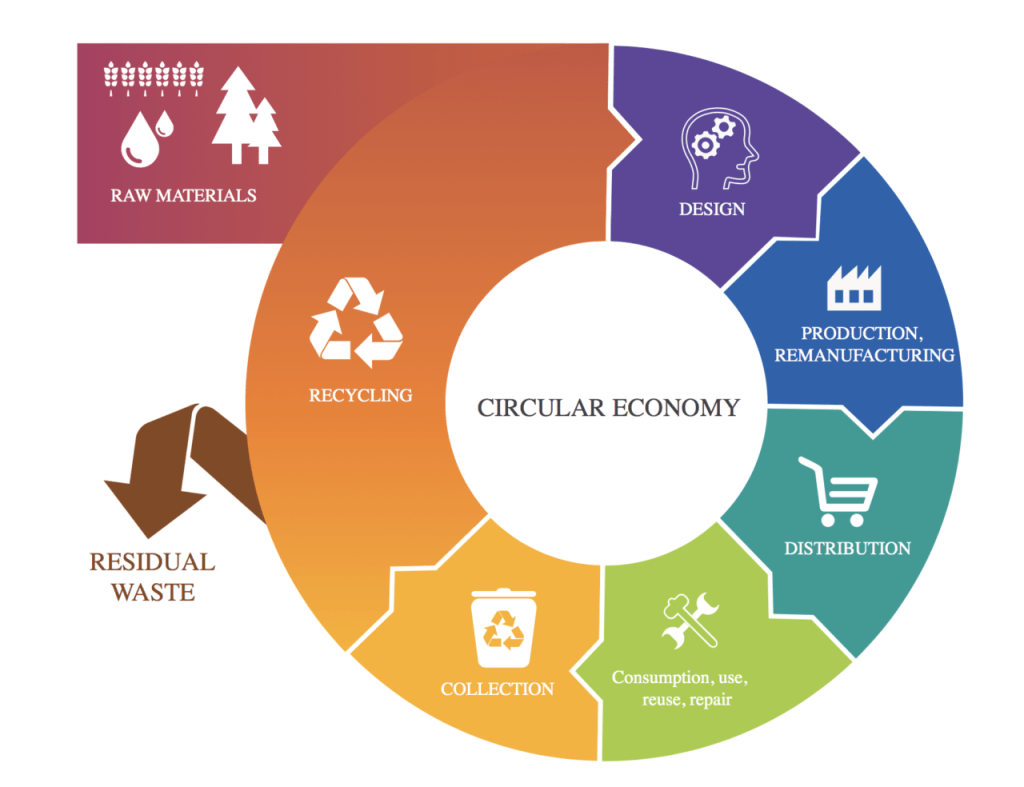
The circular economy is already being used, but not enough. Currently, only 8.6% of the economy is circular.
So what do we do? Here are four words you need to know. Reuse, Re-sell, Repair, Rent.
Lots of companies use these ideas, especially clothing companies, one of the biggest polluters. For example, Poshmark resells, Patagonia repairs, Rent the Runway rents, and Alex Mill reuses. Finding brands to purchase your clothes from that use these ideals are such a more sustainable choice, contributing to this circular economy.
But it’s not just clothing companies. Fairphone, a somewhat new phone company, makes a phone that is easily repairable, having a 10/10 reparability rate. The IPad on the other hand has only a 2/10 repairable rate, and if it breaks, you are probably just going to buy a new one.
Another potential with the circular economy is job potential. There are so many jobs available, like green jobs, repair jobs, and many local opportunities. The future is circular, and it is time to act now.
For more information, check out these websites below.




 The Current Environmental Crisis